
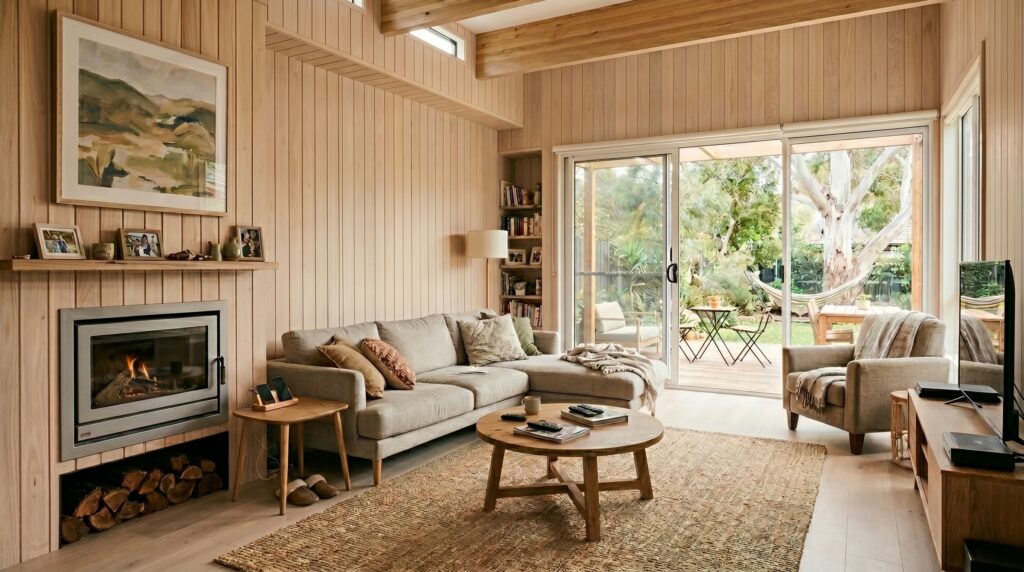
In a residential project in Adelaide, South Australia, PermaTimber® QuickBoard® V-Joint in Cherry was used as internal wall and QuickBoard ceiling lining. That is the short version. The longer version is a decision about tone, and it is the decision most people find hardest.
Why a warm tone beat a pale one in Adelaide light
The default instinct with VJ board is to go pale. White and near-white lining photographs well, it reads as safe, and it is what most people have seen in a magazine. It is also, in a lot of Australian rooms, the wrong answer.
Adelaide light is a specific thing. Summers run long, dry and bright, with the kind of high, hard glare that flattens a pale surface into something closer to blank. Winters swing the other way – cool, grey, and short on daylight hours. A room lined in a pale board has to survive both: bleached out for half the year, cold and flat for the other half.
Cherry does neither. It is a mid-to-deep warm tone with visible red underneath it, which means it absorbs harsh summer light rather than bouncing it back, and it holds warmth in the room when the daylight drops away in winter. The room reads as considered in February and as comfortable in July. That consistency across seasons is the actual argument for a warm board, and it is a much better reason to choose one than “it looked nice on the swatch”.
What the vertical joint did to room proportions
The second half of the decision was orientation, and here the V-joint itself does the work.
A VJ board is a series of evenly spaced grooves. Run those grooves vertically and the eye follows them upward, which makes a standard ceiling height feel taller than it measures. It is a genuinely useful effect in Australian housing stock, where a great many rooms sit at 2.4 metres and feel it.
Pairing that vertical lift with a deep tone is the part that takes some nerve. The received wisdom is that dark surfaces close a room in. What actually happens is that the vertical rhythm counteracts it – the grooves keep drawing the eye up, so the room gains height at the same time as it gains warmth. A dark flat wall would have felt smaller. A dark vertically jointed wall did not.
The practical stability nobody sees
There is a reason a composite VJ board suits South Australia specifically, and it has nothing to do with how it looks.
Adelaide’s seasonal swing – very dry summers, damp winters – is the exact cycle that moves traditional timber lining. Boards take up moisture, expand, dry out, contract, and over a few seasons the joins start to open and close visibly. On a wall with a deliberate, repeating groove pattern, that movement is not subtle. It is the pattern itself going out of alignment.
QuickBoard® does not absorb moisture, so the grooves stay where they were installed. The finish is factory-applied, so there is no painting, oiling or sealing to keep on top of. In a room designed around a repeating linear pattern, that stability is doing more for the final look than any single styling choice.
Living with a warm board
If you are choosing a VJ board and defaulting to pale because it feels safer, sit in the room at three in the afternoon and again at seven in the evening before you commit. A warm tone is often the braver-looking choice and the easier one to live with.
For a room-by-room breakdown of where each profile and finish suits, see our guide to VJ panelling, or order a sample and test the tone in your own light.