
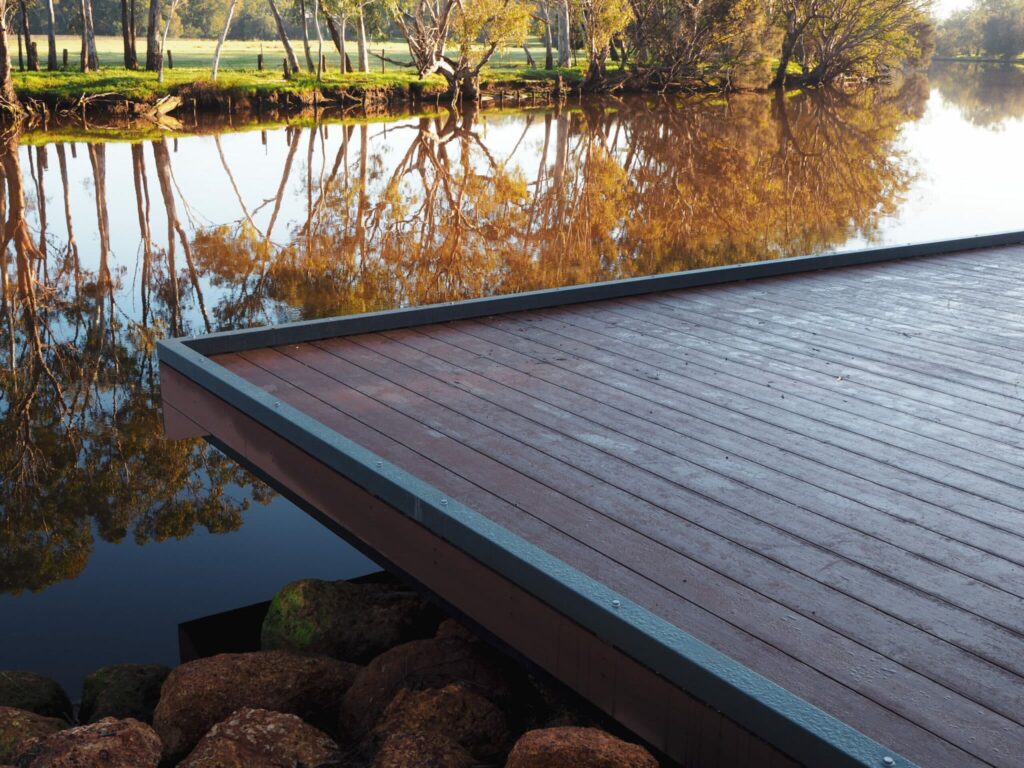
Why a public walkway isn’t just a big backyard deck
A residential deck is looked at closely by about four people. A riverfront walkway is looked at, briefly and constantly, by everyone who walks the path – runners, prams, dog walkers, cyclists slowing down for the corner. Nobody stops to inspect it. But they all register it, and what they register is not the individual board. It is the surface as a whole.
That changes what the specification has to deliver. On a small deck, a board that weathers slightly unevenly reads as character. Across a long public run, the same unevenness reads as neglect. The thing you are actually buying on a project like this is consistency across area, sustained over years, in a setting where nobody is going to come and re-oil it.
Why riverfront environments test timber performance
The Maribyrnong is a working urban river, and the ground beside it behaves accordingly. Humidity sits higher near the water than it does two streets back. Morning mist settles on the surface and stays there until the sun clears it. The path holds moisture in the shaded stretches long after the open sections have dried.
Melbourne then adds its own contribution, which is variability. A riverfront surface in Victoria can go from cold and saturated to hot and dry inside a week, more than once a season. Traditional timber responds to that by taking up water and giving it back, over and over, and the visible result over a few years is boards that no longer sit flush with each other and a colour that has drifted differently in the shade than in the sun.
Composite timber decking does not participate in that cycle. As a high-performance composite timber material, it does not absorb moisture, so it does not swell and shrink with it, and the tone that was installed is the tone that stays down.
Why mid-grey holds up against heavy foot traffic
Colour choice on a public surface is a maintenance decision disguised as an aesthetic one.
Mykonos is a mid grey-toned finish, and grey does something specific outdoors: it sits close to where most surfaces naturally drift, so dust, dried mud from the riverbank and general foot traffic do not read as strongly against it as they would against a warm brown or a deep charcoal. A dark board on a riverside path shows every dry footprint. A very pale one shows every wet one.
Grey also holds its relationship with the surroundings. Concrete path, water, eucalypt – a mid grey deck sits inside that palette rather than announcing itself against it, which on a public asset is usually the intent. The deck is meant to be part of the walk, not the feature of it.
Matching board profile to public traffic
The 146 profile is a narrower board, and on a long linear run beside a river that is doing something deliberate. The repeated joins give the surface a fine, regular grain that reads well when you are moving over it rather than standing still on it. A very wide board on a narrow path can look like flooring; a narrower board looks like a walkway.
It is a small decision. It is also the kind of decision that separates a public surface people barely notice from one they notice for the wrong reason.
Specifying composite decking for public spaces
If you are specifying composite decking for a walkway, boardwalk, park or any other surface that will be used by the public and maintained on a schedule rather than on a whim, the questions worth asking early are about consistency, slip resistance and how the surface will look in year eight.
Our guide to composite timber decking works through board width, fixing and substrate by build type, including high-traffic and commercial applications. Or get in touch with the site conditions and we will help you narrow it down.