
Most material comparisons start with the material. This one starts with the environment, because that is where the decision actually gets made. Nobody replaces a steel walkway because fibreglass grating is interesting. They replace it because something in the operating environment has been quietly eating the steel for eleven years and the maintenance budget has stopped absorbing it.
Below, five environments common on Australian sites: what each one does to steel, what it does not do to FRP, and which grating format tends to suit.
Where FRP grating fits into the job
FRP grating is used for walkways, platforms, trench covers, jetties, ramps and other trafficable surfaces in corrosive environments – water and wastewater treatment, marine and port facilities, food and beverage processing, mining and resources, and roof and plant access. Whether specified as an open mesh frp grate or a heavy-duty panel, it replaces traditional steel where corrosion and weight create ongoing maintenance overheads.
Water and wastewater treatment: where corrosion stays hidden
Wastewater treatment is one of the harshest environments in the country for metalwork, and the damage is often invisible until it is structural. In enclosed sections of a treatment plant, the gases generated by the process are aggressive to steel and to the protective coatings applied over it. On the water side, continual wetting and drying, dosing chemicals and general splash exposure work through galvanising steadily. Once the sacrificial layer is gone, the substrate is exposed and the clock speeds up.
The practical consequence is not usually a dramatic failure. It is a cycle of inspection, blasting, recoating and eventual replacement – each round requiring the asset to be taken out of service.
What it does not do to FRP. FRP grating is corrosion and rust resistant. It has no sacrificial coating to consume, because the corrosion resistance is a property of the material rather than a layer applied to it. There is nothing to recoat.
Standard mesh open grating suits most walkway and platform applications here, because open mesh lets liquid fall through rather than pool on the walking surface. Where the grating covers a channel or trench, a solid-top panel is often the better answer.
Marine, port and coastal facilities: airborne salt and continuous splash
Chloride. Airborne salt in a coastal environment attacks steel continuously, and the splash zone – the band that is alternately wet and dry – is the worst part of any marine structure to build in metal. Australian ports compound this by combining salt exposure with high humidity in the north and constant swell exposure in the south.
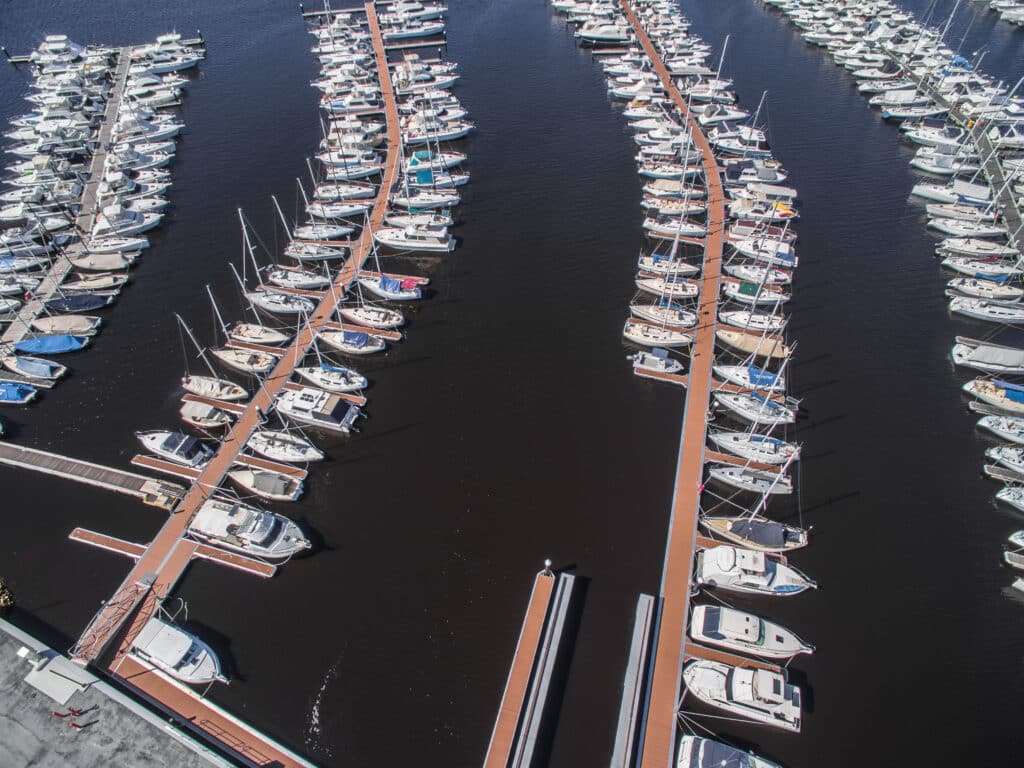
Jetties, pontoons, marina walkways and access platforms in this environment are on a maintenance schedule from the day they are commissioned, and the schedule is driven entirely by the material, not by the traffic.
What it does not do to FRP. FRP does not rust. It is also non-metallic and non-conductive, which removes galvanic corrosion between dissimilar metals from the equation entirely – a recurring problem where steel grating meets aluminium or stainless components on a marine structure.
Format. Micro mesh grating suits boardwalks, marina walkways and any public-access surface, because the smaller aperture is more comfortable underfoot and more suitable where people walk in bare feet or narrow heels. Mini mesh sits between micro and standard for general access.
Food and beverage processing: chemical washdowns and hygiene standards
Food processing floors are not corroded by the product. They are corroded by the cleaning. Daily sanitation regimes combine caustic and acidic cleaning agents with hot, high-pressure water, and that combination is far harder on metalwork than the process it is cleaning up after.
The bigger issue is what corrosion does to hygiene compliance. A pitted, flaking steel surface is a place for material to lodge, and an auditor will treat it as such regardless of how well it is cleaned.
What it does not do to FRP. FRP does not pit or flake in response to washdown chemistry, so the surface an auditor inspects in year ten is the surface that was installed. It is also low maintenance in the ordinary sense: there is no recoating cycle that has to be scheduled around production.
Format. Solid-top panels suit areas where anything falling through the frp flooring is a contamination risk or a hazard to people below. Open mesh suits wet processing areas where drainage through the floor is the priority.
Mining and resources: harsh chemicals, abrasion and thermal cycling
Australian resources sites stack several problems on top of each other. Process water is frequently acidic. Materials handling is abrasive. And inland sites cycle through very large daily temperature swings, which works joints and coatings loose over time in a way that a stable coastal climate does not.
Access structures in these environments also tend to be remote, which changes the economics. A walkway that needs recoating on a Pilbara site is not a maintenance line item – it is mobilisation, access, permits and a crew.
What it does not do to FRP. FRP grating is corrosion resistant across a broad range of chemical exposures and does not require a protective coating to stay that way. Being substantially lighter than steel, it is also easier to transport and to place on remote sites where craneage and access are constraints in their own right.
Format. Standard mesh for general walkways and platforms. Anti-slip floor plate suits areas that are wet, oily or otherwise hazardous underfoot and where a solid surface is required.
Roof and plant access: concealed damp and electrical risks
Roof walkways fail from a direction people rarely plan for: condensation. A walkway sitting above a roof sheet collects moisture overnight and holds it against the underside, in a place nobody inspects. Add the coating damage that happens during installation – cut ends, drilled holes, dropped tools – and corrosion frequently starts on day one, out of sight.
There is also a live electrical consideration on plant roofs, where access structures run near solar arrays, conduit and switchgear.
What it does not do to FRP. FRP is non-conductive, which is a meaningful safety property on a roof carrying electrical infrastructure. It does not corrode from concealed condensation, and cutting it on site does not create a corrosion initiation point the way cutting galvanised steel does.
Weight matters here more than anywhere else on this list, for a simple practical reason: everything has to be carried up. FRP flooring panels are significantly lighter than steel equivalents, meaning a smaller crew, a shorter lift and a shorter time spent working at height.
Format. Standard mesh walkway panels, typically as part of a wider access system with handrails and platforms.
Environment to format at a glance
| Environment | Primary threat to steel | Format that usually suits |
| Water and wastewater treatment | Process gases, dosing chemicals, continual wetting | Standard mesh grating; solid top over channels and trenches |
| Marine, port and coastal | Airborne chloride, splash zone exposure, galvanic corrosion | Micro mesh for public walkways and boardwalks; mini mesh for general access |
| Food and beverage processing | Caustic and acidic washdown, hot high-pressure sanitation | Solid top where fall-through is a risk; open mesh in wet processing |
| Mining and resources | Acidic process water, abrasion, inland heat cycling | Standard mesh; anti-slip floor plate for wet or oily areas |
| Roof and plant access | Concealed condensation, installation coating damage, conductivity | Standard mesh walkway panels within an access system |
Choosing a format for your site
The pattern is consistent across all five environments. The reason steel struggles is almost never the load. It is the chemistry, the moisture, or the fact that the protective layer doing the actual work is a coating that has a finite life and a maintenance cost attached to it.
PermaStruct® FRP grating can be supplied as single moulded panels or fully custom-fabricated to suit complex floor layouts, with fire resistant options where compliance requires them. For access structures more broadly – platforms, staircases, handrails, ladders and roof walkways – see the safety and access range.
Working through a specific site? Get in touch with the environment and the application, and our team will help you match the format to it.