
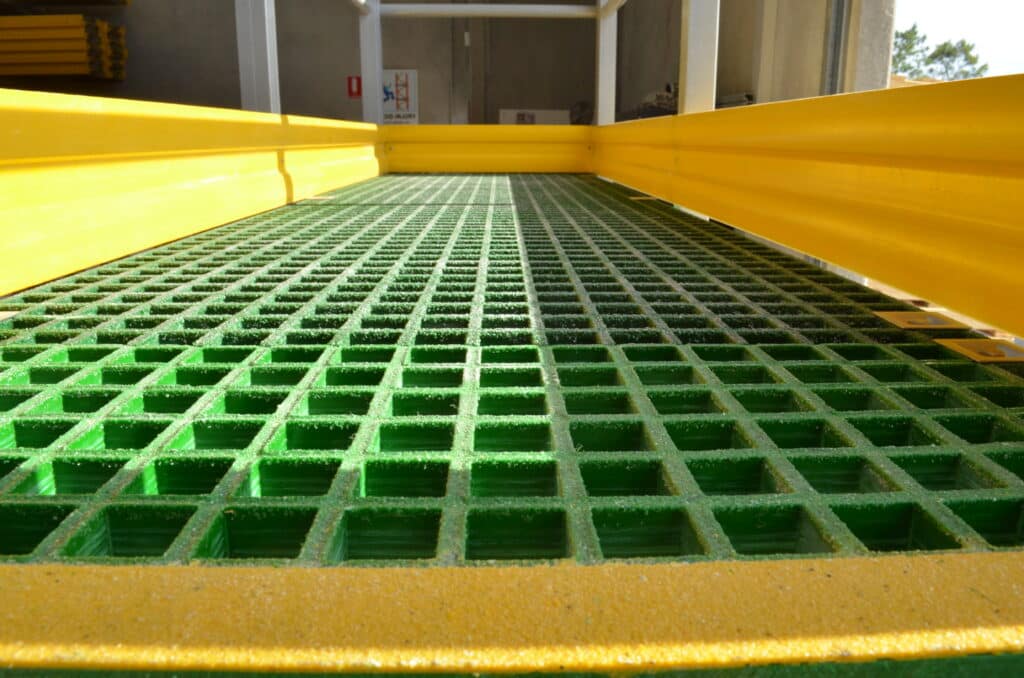
A distribution centre roof is a large, mostly empty surface that a small number of people need to reach reliably and safely, several times a year. Air conditioning plant sits on it. Solar sits on it now, almost universally. Skylights, exhaust fans and cable runs sit on it. And all of that requires periodic access by technicians who are not roofers and who should not be picking their way across roof sheeting to get to it.
The conventional answer is a galvanised steel walkway. On a warehouse roof, that answer has three quiet problems.
The first is condensation. A walkway fixed above roof sheeting creates a sheltered gap that collects moisture overnight and holds it, in a place nobody looks at because nobody has a reason to look under a walkway. Corrosion starts on the underside and progresses for years before anything is visible from above.
The second is installation damage. Every cut end and drilled hole in galvanised steel is a break in the protective layer. On a roof walkway, which is cut to length and drilled on site to suit the roof it sits on, there are a great many of those.
The third is electrical. A modern distribution centre roof is covered in solar array, inverters, conduit and switchgear. Running a continuous conductive metal structure through that environment is a consideration a safety officer will raise, and should.
Where FRP flooring takes over
PermaStruct® FRP flooring addresses all three without needing to be argued for individually.
It does not corrode, so concealed damp under the walkway is not the beginning of a failure sequence. Cutting it on site does not create a corrosion initiation point, because there is no protective coating to breach – the corrosion resistance is in the material itself. And it is non-conductive and non-metallic, which is the property that matters most on a roof carrying live electrical infrastructure.
There was a fourth reason, and on this job it may have been the most practical one. Every component of a roof walkway has to be lifted to roof level and carried into position by hand. FRP panels are substantially lighter than the steel equivalent, which means a smaller crew, fewer lifts, and less time spent working at height – which is where the real risk on a roof project sits.
The final trade takeaway
The problem was safe, repeatable access to plant on a large warehouse roof, in an environment where steel corrodes out of sight and conductivity is a live safety consideration. The material chosen was FRP, in a walkway configuration suited to intermittent maintenance access. The outcome is an access route that does not carry a recoating schedule, and does not need to be inspected for corrosion that started under it.
For roof access specifically, the safety and access range covers walkways alongside platforms, staircases, handrails and ladders. For a broader picture of where fibreglass suits and where steel struggles, our guide to FRP grating works through it environment by environment.
Have a roof or plant access problem you are working through? Get in touch with the site and the application.