
Marine infrastructure tends to fail quietly, then all at once. Timber decking on a dock looks fine for years, then an inspection turns up rot right through the substructure. Steel handrails near salt water hold paint for a while, then start weeping rust at every weld. Fiber-reinforced polymer solutions exist specifically to remove that failure cycle from marine and port structures.
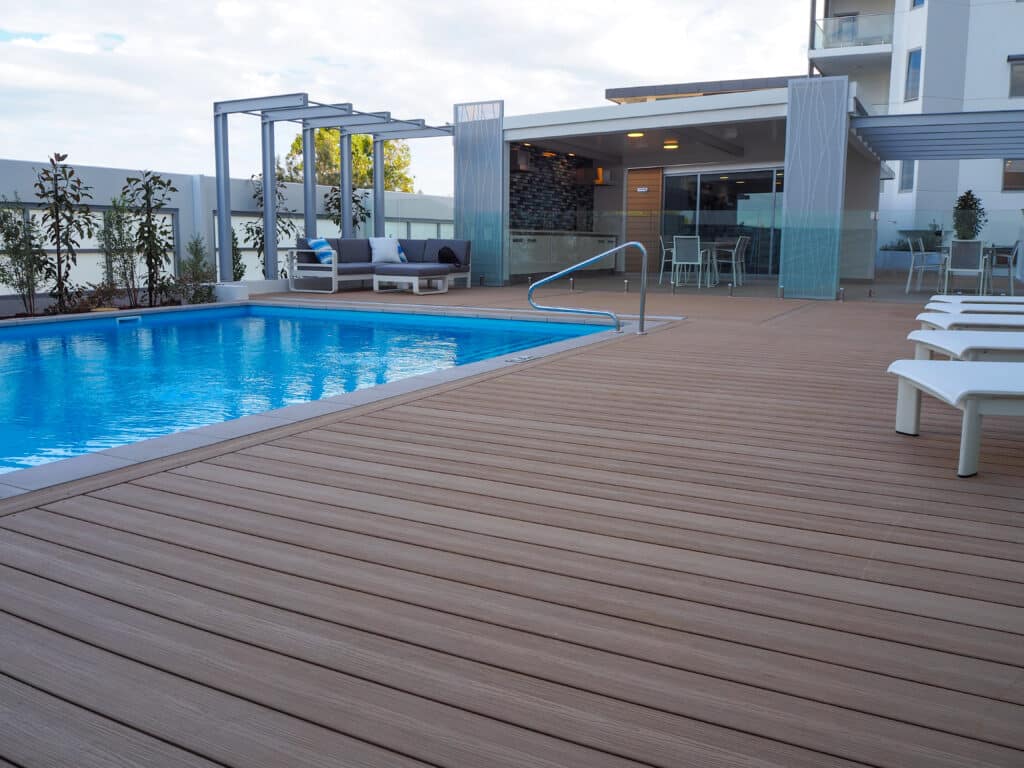
FRP decking for docks and marinas
Even early-generation FRP decking has a finite service life. Knowing when to plan a staged replacement, pontoon by pontoon, beats waiting for a failure that takes a berth out of action – or worse, becomes a safety hazard on a public walkway.
FRP decking does not rot, rust, or delaminate the way timber or lower-grade materials can. It withstands constant salt spray, heavy foot traffic, and boat wash without surface degradation. When comparing composite decking against another round of timber replacement, low maintenance requirements over 10 to 15 years usually decide the outcome. Factor in the labour cost of re-decking a dock every few years, plus downtime while it is out of service, and the comparison closes quickly in FRP’s favour.
FRP grating for wharf and port structures
Port projects typically involve a broader scope than a single deck. FRP grating for a wharf upgrade is often specified alongside stainless steel columns and several other trades, forming one line item in a package that must also account for tidal movement and maintenance crew access.
For platforms, walkways, and trench covers in these environments, an FRP grate panel provides a non-metallic, non-conductive, slip-resistant surface. It will not corrode in salt air or chemical exposure – a real problem for steel grating in the same locations. Our PermaStruct® FRP grating range comes as single moulded panels or custom-fitted to complex layouts, which helps on a wharf where very little is a standard rectangle. Fire-resistant options are also available where project compliance calls for them.
Beyond decking: hardware replacing concrete
Not every marine enquiry is about a walking surface. Wharf-front wheel stops are a prime example of fibreglass-reinforced plastic stepping into roles that used to default to concrete or steel. They are lighter to handle on site, easier to install without heavy lifting gear, and immune to salt-driven degradation that eats away at concrete edges over time. It is a smaller job than a full decking or grating package, but the same underlying logic applies: anything sitting permanently in salt air is a candidate for FRP.
FRP handrail where steel and stainless struggle
Handrail decisions near water usually come down to a direct comparison against steel and stainless steel. Specifiers weigh up cost, outdoor durability, installation effort, and performance in corrosive conditions that accelerate metal fatigue well beyond what standard marine-grade coatings can handle.
That is the scenario PermaStruct® FRP handrail is engineered for. Certified to AS1657, it does not corrode and weighs 60–70% less than galvanised steel or stainless equivalents. That lighter footprint means less heavy plant and fewer hands needed to install it on an elevated structure. Ergonomic top rails, knee rails, and kick plates come standard, making it a straight swap for a compliant handrail system rather than a custom design exercise.
Building a full access structure
If your project is a complete boardwalk or walkway system rather than a decking, grating, or handrail replacement, pultruded substructures and site fabrication become central to your scope.
What to send us
For any marine or port enquiry, send us three key details:
- The structure you are working on
- Rough dimensions or total square metreage
- Any compliance requirements, such as AS1657 or a specific load rating
Get in touch with those details and our technical team will return a scoped specification.